Big money, fighting for control.
Conservative, centrist, single-issue, crypto, liberal — a menu of sides. Follow the money behind the biggest super PACs of each and you keep arriving at the same short list of billionaires and industries.
This is the present-day sequel to the legal history: what the money actually looks like now that spending is speech and the limits are gone. We name the top PACs in each lane and their largest known funders, from public filings. And we are honest where the pattern breaks — union and small-dollar money is a genuinely different thing, and we do not pretend otherwise.
What this page is about
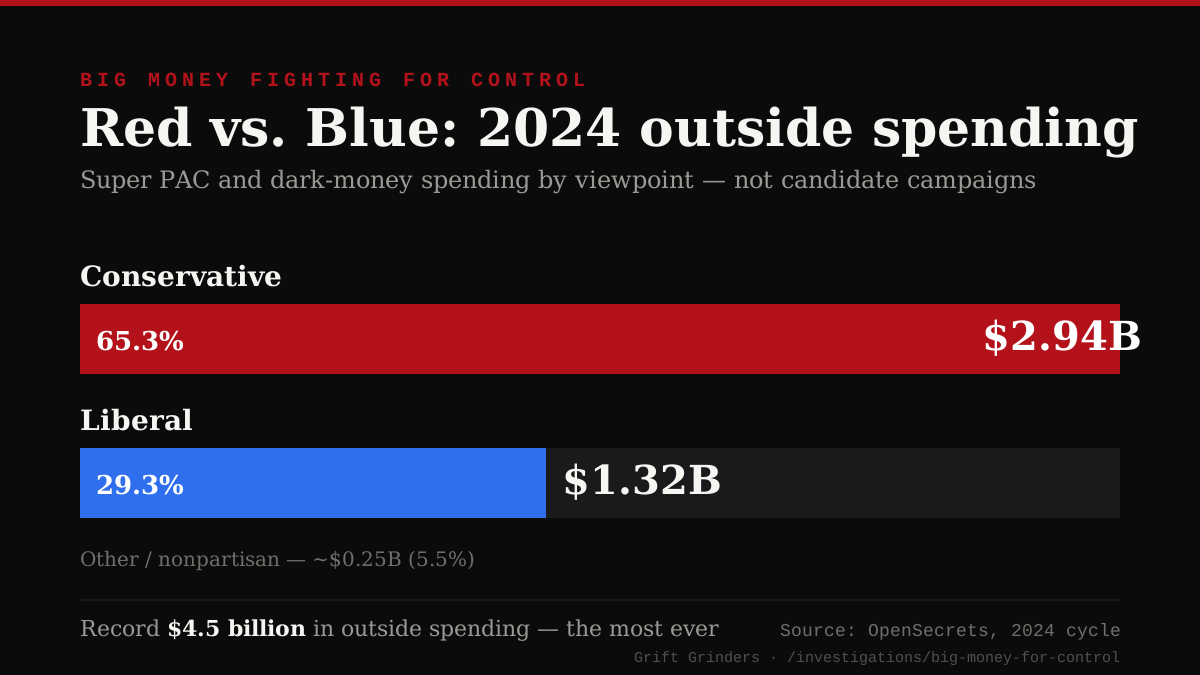
In the 2024 federal elections, dark money hit a record of roughly $1.9 billion, and outside groups spent at a scale that would have been illegal before Citizens United. This page catalogs the dominant super PACs across the apparent spectrum — conservative, centrist, single-issue, crypto, and liberal — and, from public filings, names the biggest ones and their largest known funders. The recurring finding is that the money at the top is highly concentrated: a relatively small set of billionaires and industries stands behind super PACs that present as opposing teams. The 2026 cycle only sharpened it — a Washington Post tally of FEC data found the top 50 donors had already put more than $1.6 billion into federal politics, tilted roughly two-and-a-half to one toward Republican-aligned money.
We are careful about what that does and does not prove. The funding numbers are documented fact. The stronger reading — that the sides are, in effect, a managed illusion — is an argument advanced by watchdogs like Public Citizen, and we present it as that. And we flag the real exception: labor unions fund large PACs too, but from pooled member dues, which is not the same as a single donor writing a nine-figure check.
Books that go deeper on this story. Links are Amazon affiliate searches — buying through them supports the work at no cost to you.
The same investigation, restaged one beat at a time. Step through it here, or present it fullscreen.
Big Money Fighting for Control of the US Government
The post-Citizens United PAC landscape, lane by lane — conservative, centrist, single-issue, crypto, liberal — with the biggest super PACs and their largest known funders named from public filings. A companion to Normalizing Corruption. Funding = FACT; the 'illusion of sides' is an attributed thesis; labor/small-dollar money is marked as the exception.
Five lanes, one short list of funders
The scale: a record ~$1.9 billion in dark money in 2024.
FACTThe backdrop is money at a volume the pre-Citizens United system did not allow. The Brennan Center found that dark money — political spending whose original source is hidden, typically routed through 501(c)(4) nonprofits — reached a record of roughly $1.9 billion in 2024 federal races, and total spending by political groups for the cycle ran into the tens of billions. Crucially, this is not a one-party story: reporting found that Democratic-aligned groups actually held the largest share of dark money in 2024. The rest of this page is what that river of money looks like, lane by lane.
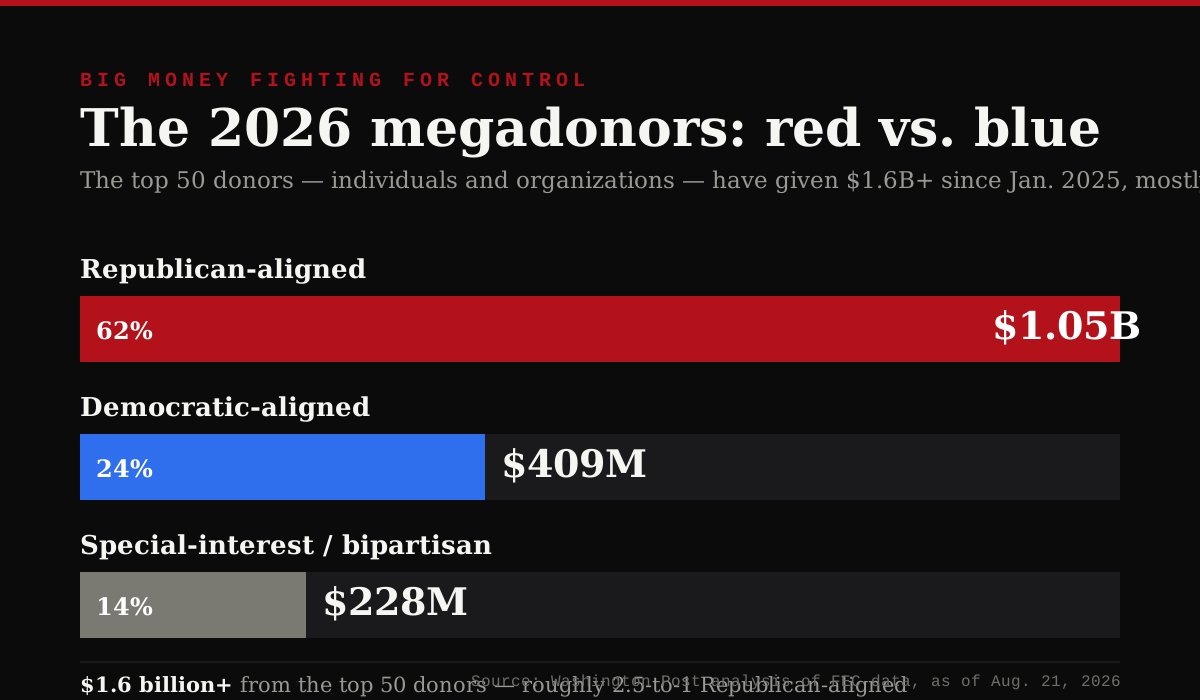
The 2026 update: the top 50 donors have already put $1.6 billion+ into federal politics — and it tilts ~2.5-to-1 right.
FACTA Washington Post analysis of Federal Election Commission data (published June 25, 2026; figures as of Aug. 21, 2026) found the biggest donors of the 2026 cycle had already given more than $1.6 billion — the sum of its top-50 donor list — mostly to super PACs. A precise reading matters: this counts disclosed contributions to federal political committees since Jan. 1, 2025, and the 'top 50' is a mix of wealthy individuals/couples and organizations (super-PAC-feeding nonprofits, crypto firms, trade groups, a union). By the Post's own party breakdown, Republican-aligned money leads at about $1.05 billion (~62%), versus roughly $409 million Democratic-aligned (~24%) and about $228 million special-interest/bipartisan (~14%) — a lead of roughly 2.5-to-1. The top ten individual donors, per the Post: George Soros ($102M, the only Democrat in the ten), Jeff and Janine Yass ($93.8M), Ben Horowitz and Marc Andreessen ($91.3M), Elon Musk ($90.6M), Elizabeth and Richard Uihlein ($70.0M), Miriam Adelson ($67.6M), Greg and Anna Brockman ($50.0M), Paul Singer ($37.1M), Cameron and Tyler Winklevoss ($33.2M), and Ken Griffin ($32.5M). A labeling note: the Post marks donors who endorsed President Trump as Republican, which is how several tech and crypto figures land on the right. This is disclosed FEC money, not 'all money in politics' — direct independent expenditures, candidate self-funding, and undisclosed dark money that never surfaces in filings are excluded. Note: this figure comes from the Post's FEC analysis; a widely shared Bernie Sanders post drew on the same list, but the source of record is the reporting, not the post.
'Conservative': record-breaking billionaire checks and dark-money leadership PACs.
FACTThe right is where the individual checks got largest. The main pro-Trump super PAC, MAGA Inc., has raised roughly $305 million since the 2024 election — an unprecedented sum the Brennan Center called five times the prior record for a president's super PAC in the year after winning. The megadonors behind the 2024 effort: Elon Musk spent at least $250 million, most of it through his America PAC; Timothy Mellon, the reclusive banking heir, poured about $165 million into the cycle (including $50 million to MAGA Inc. the day after Trump's conviction); Miriam Adelson gave roughly $100 million to the pro-Trump Preserve America PAC; Jeff Yass, co-founder of Susquehanna, directed on the order of $100 million to Republican groups (including about $16 million to Club for Growth Action); Richard Uihlein put roughly $59 million into his Restoration PAC; and Isaac and Laura Perlmutter gave $10.1 million to the newer super PAC Right for America. The party-leadership vehicles — the Congressional Leadership Fund (~$243 million in 2024) and the Senate Leadership Fund — are fed heavily by corporate and Wall Street money and by their affiliated 'dark money' 501(c)(4) arms, One Nation and Securing American Greatness, which move tens of millions into the super PACs without disclosing the original donors. Networks tied to Leonard Leo's Concord Fund and to Musk have separately bankrolled state-legislative and judicial races. The NRA's Political Victory Fund anchors the gun lane.
- Brennan Center — 'Pro-Trump Super PAC Raises Record-Breaking $305 Million' (MAGA Inc.)
- PBS NewsHour — Musk spent at least $250M backing Trump in 2024 (America PAC)
- OpenSecrets — Timothy Mellon poured over $165 million into the 2024 elections
- Campaign Legal Center — dark-money groups (One Nation, Securing American Greatness) pumping millions into 2024
'Centrist / moderate': corporate, pharma, finance, and tech — and increasingly open about it.
FACTThe self-styled 'moderate' infrastructure runs on corporate, finance, and tech money, and its own leaders have grown candid about it. Third Way — a think tank that shapes centrist Democratic policy and is organized as a 501(c)(4) that need not disclose donors — has had a senior officer concede that the majority of its support comes from its board of trustees, most of them Wall Street and business executives; its documented corporate donors include the drugmaker Amgen, the pharmacy-benefit and insurance conglomerate CVS Health, and Baxter International. In 2025 Third Way announced a $15 million campaign running through 2028 to counter the Democratic Socialists of America — its president called the DSA a 'mortal danger' to the party — and it has publicly urged Democrats to rely less on small-dollar grassroots donors and more on major institutional checks. The candidate-money side is billionaire-fueled: WelcomePAC has drawn roughly three-quarters of its individual funds from the ultra-wealthy — Reid Hoffman (more than $1.8 million), James and Kathryn Murdoch ($2.5 million), Bain Capital co-chair Joshua Bekenstein and his wife ($375,000), and members of the Walton family — while Hoffman separately bankrolls Mainstream Democrats PAC (more than $1.5 million), which spends to beat progressives in Democratic primaries. The Center for New Liberalism is funded through the New Democracy PAC, run by the centrist Progressive Policy Institute. Note on sourcing: an earlier framing alleged these groups are specifically pro-Israel-billionaire money; the documented funders are Wall Street, pharma, tech, and finance, and that is what we report.
- The Nation — Third Way: 'Majority of Our Financial Support' from Wall Street and business executives
- Common Dreams — 'Corporate-Funded Third Way Plans to Spend $15 Million Waging War on Progressives' (Amgen, CVS, Baxter; the anti-DSA campaign)
- Sludge — the billionaire money behind the new centrist pledge (WelcomePAC: Hoffman, Murdochs, Bekenstein, Waltons)
- CNBC — Reid Hoffman-backed Mainstream Democrats PAC targets progressives in Democratic primaries
Single-issue: the pro-Israel super PACs that reshaped Democratic primaries.
FACTThe clearest single-issue example is a pair of pro-Israel super PACs that became among the most influential outside spenders in recent Democratic primaries. AIPAC's United Democracy Project (UDP) raised and spent roughly $68 million in the 2024 cycle, overwhelmingly in Democratic primaries; about $18.3 million of it went into two races against progressive incumbents — roughly $12.3 million boosting George Latimer over Rep. Jamaal Bowman and about $6 million helping Wesley Bell defeat Rep. Cori Bush, both of whom lost. Its Democratic-establishment counterpart, Democratic Majority for Israel (DMFI), raised about $6.75 million in 2024 and spends in the same lane. Two features stand out: nearly half of AIPAC's spending was negative — aimed at defeating candidates rather than electing them — and a growing share moves through partner and 'shell' PACs that obscure the path of the money (in the 2026 cycle, roughly $8 million of the $30.66 million disbursed by DMFI and UDP ran through nine such vehicles, per the American Prospect). By one accounting of FEC filings, AIPAC's overall 2024 political spending exceeded $125 million. These are legal independent expenditures; what makes them notable is how concentrated a single issue's money became inside one party's primaries. (We include this as one of five lanes, held to the same standard as the rest — not singled out. We looked at other country- or issue-specific networks Tim raised — Indian-American, pro-Ukraine, Cuban-American — and left them out: the Indian American Impact Fund actually backs progressive diaspora candidates rather than opposing them; American Ukraine PAC is a small traditional PAC (~$40,000 in 2024); and we found no documented super-PAC primary operation for the Cuban-American groups. We don't pad a pattern with unsupported examples.)
- FactCheck.org — United Democracy Project (AIPAC's super PAC), 2024 spending
- Punchbowl News — pro-Israel groups' spending in the 2024 Democratic primaries (Bowman, Bush)
- OpenSecrets — Democratic Majority for Israel PAC profile (2024, ~$6.75M raised)
- The American Prospect — 'The Pro-Israel Super PAC Cinematic Universe' (shell-PAC routing)
Crypto: one industry, one super PAC, $200 million.
FACTThe crypto industry demonstrated how quickly a single sector can build outsized influence. Fairshake — with affiliates Defend American Jobs and Protect Progress — spent more than $200 million in the 2024 cycle, ranking among the top outside spenders, and it is largely the creature of a few firms: Coinbase (about $75 million in commitments), Andreessen Horowitz / a16z (about $60 million), and Ripple (about $50 million). Notably, Fairshake is nominally bipartisan — it backs pro-crypto candidates of either party — which is the point: it is not a 'side' at all, but an industry buying a policy outcome. It carried roughly $193 million into the 2026 midterms.
'Liberal': the biggest single outside spender was a billionaire vehicle — with a union asterisk.
FACTThe left is not exempt — its largest super PAC outspent everyone. Future Forward USA raised about $559 million in the 2023–2024 cycle, the top outside spender of the election, and its money came heavily from a few tech billionaires: Dustin Moskovitz (about $38 million), Michael Bloomberg (roughly $50 million to its nonprofit arm plus $19 million more), and Reid Hoffman (about $10 million). The Senate Majority PAC and House Majority PAC (the party-leadership vehicles) and American Bridge round out the top tier, and wealthy liberals increasingly route money through 501(c)(4) nonprofits — which is how Democratic-aligned groups ended up with the largest dark-money share in 2024. THE ASTERISK: large union PACs (SEIU, AFSCME) also rank among the biggest Democratic-aligned spenders, but they are funded by pooled member dues, not billionaire checks. That is a materially different model, and we count it as the exception to this page's pattern, not an example of it.
Unlimited money, one rule: don't touch the campaign
Whatever their ideology, these super PACs share one legal constraint: they may raise and spend unlimited sums, but they may not give directly to a candidate or coordinate with the campaign. So the money goes out as independent expenditures — a parallel campaign running alongside the official one. In practice the great majority of it becomes advertising: studies by the Center for Public Integrity have found super PACs airing more ads than the candidates themselves. A rough, oft-cited pattern of how a big super PAC's budget splits — a tendency, not an audited rule:
- Media & advertising — the large majority (frequently 60–85%): TV, radio, digital, and streaming ad buys.
- Field / ground game (~10–20%): canvassing, voter registration, get-out-the-vote.
- Strategy, polling & data (~5–10%): focus groups, voter files, opposition research.
- Fundraising & overhead (~2–5%): legal compliance, accounting, donor events.
The mission bends the emphasis, in patterns researchers have documented: conservative super PACs lean into heavy media blitzes and negative/attack advertising; liberal ones put more into field operations and labor-linked organizing to turn out lower-propensity voters; centrist/establishment groups concentrate on defending incumbents and beating primary challengers to hold party control; and single-issue groups (AIPAC, the pro-crypto PACs) run a targeted, cross-party primary strategy — spending in either party's primaries to reward allies and defeat opponents on their one issue. Because they cannot coordinate, the result is often a shadow campaign that outspends the candidate it is helping — the everyday face of the law traced in Normalizing Corruption.
What this page does — and refuses to do
- Union and small-dollar money is not the same thing. SEIU and AFSCME run big PACs, but on pooled member dues. Lumping that in with a billionaire's nine-figure check would be dishonest, so we mark it as the exception, not the rule.
- We report the funders we can source. For the “moderate” lane, the documented money is Wall Street, tech, and finance. We could not verify the claim that it is specifically pro-Israel-billionaire money, so we don't make it.
- Funding is fact; “illusion of sides” is an argument. The dollar figures are public record. The interpretation — that the menu of sides is effectively managed by one donor class — is a case watchdogs make, and we attribute it rather than declaring it proven.
- No selective outrage. We document the biggest money on the right, the center, and the left with the same standard. The subject is the system Citizens United built, not a scorecard for one team.
This is what the law from the last page bought
The reason a single industry can drop $200 million, or one person can write a $100 million check, is the legal machinery traced in Normalizing Corruption — Buckley, Citizens United, SpeechNow. This page is the receipt. Whether or not you accept that the “sides” are an illusion, the concentration at the top is documented, and it is the engine beneath the money-in-politics record the Return on Investment hub tracks, alongside the Self-Dealing file on what that access buys. The healthy version of democracy this is measured against is simple: many voices, not a handful of very loud checkbooks.
Questions worth taking seriously
Aren't labor unions just as guilty as billionaires here?
We deliberately don't say that. Union PACs (SEIU, AFSCME) are large, but they're funded by pooled dues from millions of members — many small contributions aggregated — which is a fundamentally different model from one billionaire writing a nine-figure check. You can criticize union political spending on other grounds, but equating the two funding structures would be inaccurate, so we mark labor as the exception, not an example.
Is this saying both parties are secretly the same?
No. Parties differ on policy, and voters have real choices. What the record shows is narrower: at the very top of outside spending, the money is highly concentrated among a small donor class and a few industries — on the right, the center, and the left alike. That's a documented fact about who funds the biggest super PACs, not a claim that the sides are identical or that one group controls everything.
Why single out AIPAC?
We don't single it out — it's one of five lanes here, alongside conservative, centrist, crypto, and liberal money. It's included because it's the clearest recent example of a single issue's money reshaping one party's primaries: AIPAC's super PAC spent roughly $68 million in 2024, including about $18.3 million to defeat two progressive incumbents who lost. Those are legal independent expenditures and public filings; we report the numbers and attribute any characterization, exactly as we do for every other lane.
Corrections and context
This page is built from FEC filings, OpenSecrets and Brennan Center data, and mainstream reporting, and it deliberately distinguishes billionaire money from union and small-dollar money, and documented funders from unverified claims. If you are named here and believe a figure is wrong or a characterization unfair, tell us and we will correct it, through the contact channels on our mission page.
The record
- Brennan Center — dark money hit a record ~$1.9 billion in 2024
- The Washington Post — the biggest donors of the 2026 cycle (FEC analysis; $1.6B+ from the top 50, ~2.5-to-1 Republican-aligned)
- OpenSecrets — Congressional Leadership Fund (2024, ~$243M)
- Forbes — Miriam Adelson's ~$100M to a pro-Trump super PAC
- The Nation — Third Way's majority Wall Street funding
- Common Dreams — the billionaire finance money behind the centrist pledge (WelcomePAC)
- FactCheck.org — AIPAC's United Democracy Project (2024 spending)
- Punchbowl News — pro-Israel money in the 2024 Democratic primaries (Bowman, Bush)
- CNBC — Coinbase, a16z, and others fund the pro-crypto super PAC Fairshake
- OpenSecrets — Future Forward USA (top outside spender, ~$559M)
- The New York Times — liberal billionaires and dark money in 2024