The interest trap.
The interest on the national debt just passed the entire Pentagon budget — the fastest-growing line in the federal ledger, money spent before a single program dollar. The alarm is real. So is the way out. And both parties have decided not to take it.
This one started with a reader's napkin math: a 10-year Treasury at 6 percent on a $40 trillion debt is $2.4 trillion a year in interest, bigger than Social Security, and we can't sustain it. The alarm is right. Two of the numbers aren't — not yet — and the honest version turns out to be sharper than the scary one, because the fix is arithmetic and the refusal is a choice.
What this page is about
In fiscal year 2025 the federal government spent about $970 billion just on net interest on the debt — and for the first time in modern history, that bill was larger than the entire national defense budget (about $917 billion). Interest is now the fastest-growing line in the budget. Treasury's own 2025 financial report says in plain language that the path is “unsustainable.” On that, the alarm is correct, and we are not going to soften it.
We do correct the arithmetic. The scary figure — $2.4 trillion a year — assumes a 6 percent interest rate on the whole debt. The actual average rate the government pays is about 3.6 percent, because most of the debt is locked in at older, cheaper terms and rolls over only slowly. So the $2.4 trillion is not today's bill; it is roughly where the Congressional Budget Office projects we are headed by the mid-2030s. Interest is not yet bigger than Social Security (about $1.5 trillion) — it just passed defense. The trajectory is the story, and it is bad enough without rounding up.
The part worth sitting with is the exit. Simply letting the 2017 tax cuts expire would save roughly $4 trillion over a decade (CBO). Going all the way back to Clinton-era rates, with a few base-broadening moves on top, can plausibly reach the $10–12 trillion our reader named — but the honest footnote is that full Clinton-era rates raise taxes on the middle class too, not only the rich. That is a large reason no one will touch it. Republicans are actively cutting in the opposite direction; Democrats have pledged not to raise anything under $400,000. So the deficit that is called an emergency is used to justify cutting programs people paid into — while the revenue side that dug most of the hole stays off the table.
The same investigation, restaged one beat at a time. Step through it here, or present it fullscreen.
The Interest Trap.
Interest on the national debt just passed the entire Pentagon budget — the fastest-growing line in the federal ledger. The alarm is real. So is the arithmetic way out. Both parties have decided not to take it.
The napkin, checked against CBO
Interest on the debt just passed the Pentagon — the first time in modern history.
FACTThis is the real milestone, and it is more concrete than the napkin version. In fiscal year 2025 net interest on the federal debt reached about $970 billion, overtaking national defense spending (about $917 billion) for the first time in modern U.S. history. Interest is money spent before a single program dollar — no road, no benefit, no soldier — and it is now the fastest-growing part of the budget. The total gross debt stood at roughly $37.85 trillion in late 2025 and is climbing about $2.2 trillion a year, so the reader's '$40 trillion' is rounding up by about a year, not inventing a number.
'10-year at 6% → $2.4 trillion a year' — that is a forecast, not today's bill.
PROBABLY TRUEGraded as a trajectory, not as a description of the present. The $2.4 trillion comes from applying a 6 percent rate to the whole $40 trillion debt. But the government does not pay 6 percent on the whole stock: the average interest rate on federal debt is about 3.6 percent, because most of it is locked in at older, lower rates and rolls over only gradually. So today's actual net-interest bill is about $970 billion, not $2.4 trillion. Where the napkin is right is the direction: CBO projects net interest will roughly double, reaching about $2.1 trillion by the mid-2030s under current law. The reader isn't wrong about the number — they're early, and they've skipped the years of rollover that get us there.
'Bigger than the entire Social Security disbursement' — not yet; it just passed defense.
FALSE / MISLEADINGAs a statement about today, this one doesn't hold, and the discipline is to correct it even when it points the right way. Social Security outlays run about $1.5 trillion a year and remain the single largest line in the budget; net interest, at about $970 billion, is below that. What interest has passed is national defense. The 'bigger than Social Security' claim is true only of the high-rate scenario (the $2.4 trillion figure) or of the later-2030s trajectory, where CBO shows interest approaching and potentially overtaking most major programs. We grade the literal present-tense claim false/misleading, and keep the accurate version: interest now exceeds the Pentagon and is closing on everything else.
The shortfall is substantially a revenue choice, not only runaway spending.
PROBABLY TRUEThis is an analytic claim, well supported but not beyond argument, so PROBABLY TRUE. Federal revenue has run around 17 percent of GDP while outlays run several points higher, and independent analysts attribute a large share of the long-run rise in debt-to-GDP to the Bush-era and 2017 tax cuts, which were not paid for. The honest counterweight: an aging population drives Social Security, Medicare, and now interest upward regardless of tax policy, so this is not purely a revenue story. But the specific, repeated decision to cut taxes at the top without offsetting it — and then to call the resulting gap a spending emergency — is a choice, and it is the choice this site exists to document.
For broader context: the top tax rate was 91% under Eisenhower — the rich paid more then, but nowhere near 91%.
FACTThis is the baseline the modern debate has forgotten, and it is worth getting exactly right. The highest marginal federal income-tax rate peaked at 94 percent in 1944 and sat at 91 percent through the Eisenhower years (92 percent in 1952–53); today it is 37 percent. That much is simple fact. But the honest fence matters, because the headline is routinely overstated: almost no one paid 91 percent on all their income. The 91 percent applied only to income above a very high threshold, and deductions and shelters were everywhere, so the top 1 percent's effective income-tax rate in the 1950s was far lower — the Tax Foundation puts it near 17 percent, while the Tax Policy Center finds the effective rate on top-bracket income ran about 49 percent, versus roughly 35 percent today. So the rich did pay materially more then than now — just nowhere near the number people quote. And here is the part both sides skip: federal revenue has stayed near 17 percent of GDP through every one of these rate regimes, which is why the realistic revenue lever today is reversing the Bush and Trump cuts, not literally restoring 91 percent.
Just letting the 2017 Trump tax cuts expire would save about $4 trillion over a decade.
FACTThis is the concrete, scoreable piece of the exit, and it requires no new taxes at all — only letting an existing law lapse as written. CBO and the Peterson Foundation put the 10-year cost of extending the expiring 2017 Tax Cuts and Jobs Act provisions at roughly $4.0 trillion (the Tax Foundation's figure is about $4.5 trillion including related provisions; the Joint Committee on Taxation scores the individual provisions alone at about $3.4 trillion). In other words, before anyone debates Clinton-era rates, simply not renewing the Trump cuts closes a $4 trillion hole over the next ten years. Congress chose to extend them instead.
'Clinton rates plus a few adjustments → $10–12 trillion saved' — reachable, but it's a middle-class tax increase too.
PROBABLY TRUEGraded as an order-of-magnitude, with the footnote that makes it honest. The menu that gets you there stacks up: letting the Trump cuts expire (~$4 trillion), restoring the Clinton-era corporate rate of 35 percent from today's 21 percent, taxing capital gains closer to ordinary income, and reviving a stronger estate tax. Stacked over a decade, $10–12 trillion is a defensible high-end figure. But two caveats keep it from being a free lunch: full Clinton-era individual rates applied to lower income thresholds than today's, so 'going back to Clinton rates' is a tax increase on the middle class as well as the rich; and 'a few adjustments' is doing heavy lifting — the corporate, capital-gains, and estate pieces are where most of the money is. The number is real. The politics of who pays it is exactly why it never moves.
'No Republican is going to do that. Trump isn't going to do that' — correct, and the refusal reaches across the aisle.
FACTOn the Republican half, this is simply the record. The party passed the 2017 cuts on a party-line vote, moved in 2025 to extend and expand them, and Trump has campaigned on further cuts, not increases. So the specific prediction holds. The fuller truth is bipartisan and sharper: Democrats have pledged not to raise taxes on anyone earning under $400,000, which rules out the full Clinton-era reversion from their side too, because that reversion would reach well below $400,000. Neither party will do the thing that actually closes the gap on the revenue side. That leaves one politically easier lever — cutting the programs people depend on — which is the austerity move this hub tracks.
How a rich country talked itself into being broke
Step back far enough and the scale of the change is startling. For two decades after World War II — through the Eisenhower boom Americans now remember as the golden age of the middle class — the top marginal tax rate sat at 91 percent, after peaking at 94 percent in 1944. The country built the interstate highways, expanded the universities, sent a generation to college on the GI Bill, and grew the largest middle class in its history with a top rate more than double today's — and the national debt fell from its wartime peak of more than 100 percent of GDP to about a quarter of it. None of that proves high rates caused the boom, and, as the graded claims above say plainly, almost no one actually paid 91 percent. But it does puncture the modern article of faith that a high top rate must wreck growth. It didn't.
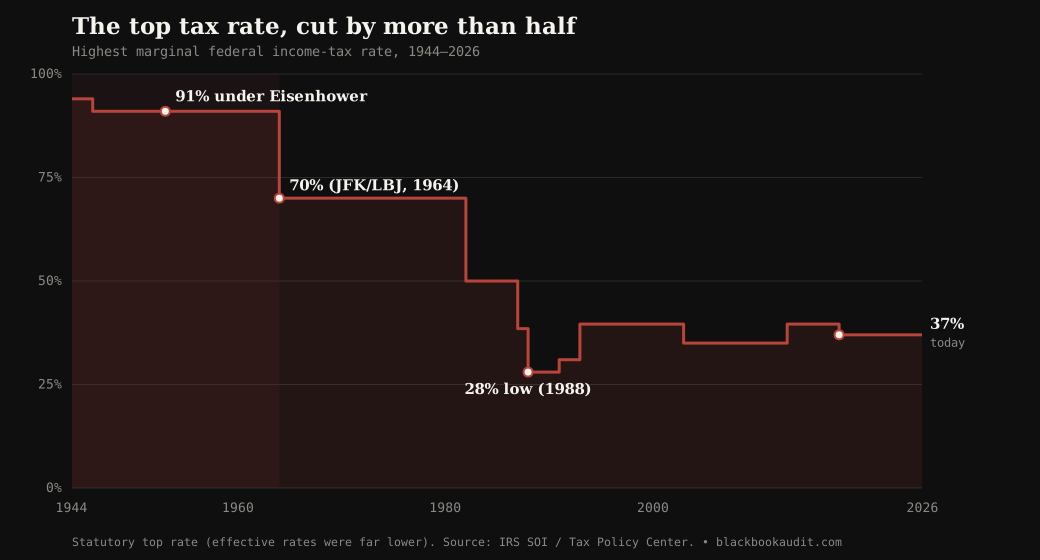
The interest bill did not arrive by accident, and it did not begin in 2025. It is the compounding tail of a sixty-year project. The slide started in 1964, when the Kennedy–Johnson tax cut brought the top rate down to 70 percent, and it never really stopped. In 1981 the Reagan tax cut began the modern experiment: cut rates at the top, promise the growth would pay for it, and watch the debt nearly triple over eight years instead. In 2001 and 2003 the Bush cuts converted a projected federal surplus — a government that was briefly paying debt down — into sustained deficits. In 2017 the Tax Cuts and Jobs Act did it again, scored by CBO at roughly $1.9 trillion in added deficits, passed on party lines, and sold with the promise it would pay for itself; corporate tax receipts fell by nearly a third the next year. We trace that pattern in Deficit Hawks Only Out of Power and The Trickle-Down Myth.
There was a name for the strategy, said out loud by the people running it: starve the beast. Cut the revenue first, let the deficits build, and then point at the deficits to argue that government must shrink. The debt was never only a mistake; for part of the movement it was the plan — a way to make the math force cuts that could never win on their own merits. The interest we now pay is the carrying cost of that plan. Every year the cuts went unpaid-for, the government borrowed the difference, and the lenders — bondholders, foreign governments, the wealthy who buy Treasuries — have been collecting ever since. A large share of the fastest-growing line in the budget is, in effect, a transfer from taxpayers to the people who had enough spare money to lend the government the taxes it chose not to collect.
This is why the debt matters in the way it actually matters — not as a looming default (a government that borrows in its own currency does not go bankrupt like a household), but as a slow squeeze. As interest crowds the budget, every other choice gets harder, and the squeeze is used as leverage: there is no money for child care or housing or care for the old, we are told, so those must be cut. The one thing never described as optional is the tax cut that created the gap. That inversion — spending is a luxury, low taxes at the top are a law of nature — is the austerity myth itself, which is why this page sits in The Austerity Myth.
Who gets cut to pay the interest?
Here is the trap in a sentence. The interest on the debt is real, it is rising, and it has to be paid. There are only two sides to that ledger: collect more, or spend less. The revenue side — undoing the tax cuts that drove most of the borrowing — has been declared off-limits by both parties. So the pressure flows to the only valve left open: the programs ordinary people paid into and depend on. The deficit built by tax cuts for the top becomes the argument for cutting Medicaid, food assistance, and eventually Social Security for everyone else. The people who got the cut are not the people who get the bill.
That is not an abstract worry. It is the live fight over every budget: the same lawmakers who voted to extend trillions in tax cuts turn around and describe the resulting deficit as a crisis requiring sacrifice — from somebody else. The honest framing our reader reached for is the right one: this is sustainable or not depending on choices we are making right now, and the choice on the table is to protect the tax cut and cut the safety net instead of the reverse.
- If letting one law expire saves $4 trillion and reverting to Clinton-era rates saves far more, why is “we can't afford it” aimed at food stamps and Medicaid instead of at the tax cut that created the gap?
- A rising share of the fastest-growing line in the budget is interest paid to bondholders — the wealthy and foreign governments who had the spare cash to lend. Is the debt a burden on the public, a payment stream to the already-rich, or both at once?
- Full Clinton-era rates would raise taxes on the middle class, not just the top. Is the real reason “no one will do it” that it's unfair — or that the part that polls well (taxing the rich) doesn't raise enough alone, and the part that raises enough doesn't poll well?
- Both parties agree the path is unsustainable and both refuse the one lever that most closes it. When the disagreement is theater and the refusal is shared, who exactly is the deficit emergency for?
Questions worth taking seriously
So is the reader's math wrong?
The alarm is right; two of the numbers are early. A 6 percent rate on the whole debt would be about $2.4 trillion a year, but the government pays about 3.6 percent on average because most of the debt is locked in at older, cheaper terms, so today's actual net-interest bill is about $970 billion. Interest is not yet bigger than Social Security — it just passed defense. But the direction is exactly right: CBO projects interest roughly doubling toward $2 trillion by the mid-2030s, and Treasury itself calls the path unsustainable. We corrected the present-tense figures and kept the trajectory, which is the part that matters.
Wouldn't 'going back to Clinton rates' only raise taxes on the rich?
No, and that's the honest part people skip. The Clinton-era individual brackets applied higher rates at lower income thresholds than today's, so a full reversion raises taxes on the middle class too, not just the top. The pieces that hit mostly the wealthy — a 35 percent corporate rate, taxing capital gains like wages, a stronger estate tax — are real money, but the headline “$10–12 trillion” needs the broad individual reversion as well. That's precisely why neither party will do it: the version that polls well doesn't raise enough, and the version that raises enough doesn't poll well.
If the government can't go bankrupt, why does the interest matter?
Because the danger isn't a sudden default — a government that borrows in its own currency doesn't go broke like a household. The danger is the slow squeeze. As interest grows into the largest, fastest-rising line in the budget, it crowds out everything else and becomes the excuse to cut the programs people depend on. The harm isn't bankruptcy; it's that “we can't afford it” gets pointed at the safety net while the tax cut that drove the borrowing is treated as untouchable.
If you are named on this page
If you are named on this page, or are a party materially affected by the claims made here, and you wish to respond, correct the record, or add context, use the Contact page. Responses are published verbatim alongside the original claim, with the sender identified and the date of receipt. The channel stays open for the life of the page.
This site aggregates and grades a record that other outlets and primary sources have already put on the record. Every FACT-graded claim above is sourced to court filings, government reports, sworn whistleblower disclosures, published investigative journalism, or named-source statements. The citations are the accountability mechanism; this section is how you get on the record too.
The record
- CBO — The Federal Budget in Fiscal Year 2025 (net interest ~$970B; deficit ~$1.8T)
- CBO — The Budget and Economic Outlook: 2025 to 2035
- CBO — The Long-Term Budget Outlook: 2025 to 2055 (average rate on debt ~3.6%)
- CBO — Taxes and the 10-year deficit outlook (~$20T over 2025–2034)
- U.S. Treasury — FY2025 Financial Report (debt-to-GDP ~99%; “current policy is unsustainable”)
- U.S. Treasury Fiscal Data — America's Finance Guide (FY2025 spending ~$7.01T; Social Security the largest category)
- Peter G. Peterson Foundation — cost of extending the 2017 tax cuts (~$4.0T / decade)
- Tax Foundation — extending the 2017 cuts reduces revenue ~$4.5T (2025–2034)
- Bipartisan Policy Center — CBO on the cost of the 2025 tax-cut extensions
- Center on Budget and Policy Priorities — Bush and Trump tax cuts as a driver of the debt
- Committee for a Responsible Federal Budget — interest costs now exceed defense
- Black Book Audit — Deficit Hawks Only Out of Power (who ran up the debt)
- Black Book Audit — The Austerity Myth (how “we can't afford it” is manufactured)